lecture
More than Dates: Yiddish Calendars as Cultural Agents, 1870-1914 – Live on Zoom
Nathan Cohen | Delivered in Yiddish.
Beginning in the mid-nineteenth century and until the outbreak of WWI, some Yiddish calendars / almanacs began to change their traditional character and broaden their scope. Political, social, economic, and cultural changes in both non-Jewish and Jewish societies, motivated publishers, editors, and writers to make use of the familiar and accessible format of the calendar in order to disseminate Maskilic and utilitarian ideas, as well as to bring Yiddish readers new literary works, both original and translated (at a higher or more popular level), alongside instructive insights in various fields of knowledge. All of this transformed the almanac into a kind of condensed encyclopedia and presented Yiddish as a “normal” language of culture rather than a "mere jargon.” In this presentation Nathan Cohen will provide an overview of several aspects of this highly interesting phenomenon.
About the Speaker
Nathan Cohen is a full Professor at the Rena Costa Center for Yiddish Studies at the Department of Literature of the Jewish People at Bar-Ilan University. Since 1998, he has been Associate Editor of the bi-annual journal Yad Vashem Studies. His main fields of research and teaching include the cultural history of the Jews of Eastern Europe in the nineteenth and twentieth centuries, the history of the book and reading in Yiddish, modern Yiddish literature, the Jews of Poland between the two world wars, and Yiddish literature and culture during the Holocaust period. He is the author of Books, Writers and Newspapers: The Jewish Cultural Center in Warsaw, 1918-1942 (Jerusalem: Magnes Press, 2003, Hebrew; translated into Polish and published by the Jewish Historical Institute in 2021) and Yiddish – The Linguistic Leap from a Common Dialect to a Cultural and Literary Language (Jerusalem: The Zalman Shazar Center, 2020, Hebrew; translated into English under the title Yiddish Transformed: Reading Habits in the Russian Empire, 1860-1914, New York and Oxford: Berhahn, 2023), as well as tens of articles in peer-reviewed periodicals.
Ticket Info: Free; registration required.
Presented by:

lecture
discussion
Ruth Rubin and the Study of Yiddish Folksong Today – Live on Zoom
Ruth Rubin was a renowned folklorist and singer, who spent decades preserving the rich musical tradition of Ashkenazi Jews. Gathering over 2,000 folksongs between 1946 and 1970, she captured the voice and memory of generations who had grown up in a flourishing Yiddish-speaking environment that they had seen annihilated by Nazi destruction and Stalinist repression. Her archive lives on through YIVO's digitized Ruth Rubin Legacy project and remains an invaluable resource for scholars and musicians.
Join us for a discussion featuring new scholarship drawing on Rubin's work by Isabel Frey and Miriam Borden, moderated by Mark Slobin, in honor of what would have been Rubin's 120th birthday.
Ticket Info: Free; registration is required
Presented by:
discussion
discussion
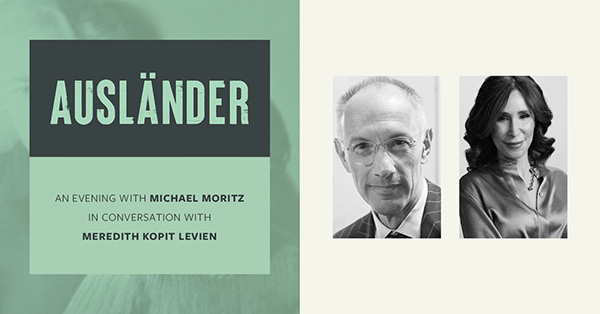
Ausländer: an Evening with Michael Moritz – In-person Event
Join the Center for Jewish History for a special conversation with Michael Moritz, celebrated investor, philanthropist, and author of the newly released memoir Ausländer: One Family’s Story of Escape and Exile.
When sorting through family papers after his mother's death, Moritz uncovered the stories of relatives murdered during the Holocaust and embarked on a journey to understand the legacy of displacement that shaped his family for generations. In Ausländer, he traces his parents' escape from Nazi Germany, their lives as refugees in Britain, and his own enduring sense of being an outsider, even after achieving extraordinary success in Silicon Valley.
Moritz will be in conversation with Meredith Kopit Levien, President and Chief Executive Officer of The New York Times Company, for a discussion about family, memory, identity, and the lessons history continues to hold for our present moment.
At once a poignant family history and a powerful reflection on identity, belonging, and the fragility of democracy, Ausländerspeaks to some of the most pressing questions of our time. Praised by critics as "brilliant" (The Economist) and "a triumph" (Jewish Chronicle), the book offers a deeply moving exploration of memory, exile, and resilience.
Don't miss this opportunity to hear Michael Moritz discuss his family's remarkable story, the process of uncovering the past, and why the lessons of history remain so relevant today.
About Michael Moritz
Michael Moritz was born in Cardiff, Wales, in 1954. A formerTIME journalist and regular contributor to the FT, he is the author of several books, including The Little Kingdom, the story of Apple's years as a private business. He was a partner in Sequoia Capital for thirty-five years and led the business between 1995 and 2012, becoming one of the most successful investors of his generation. Together with his wife, the author Harriet Heyman, he formed Crankstart in 2001—a San Francisco-based foundation devoted to helping those who might otherwise be left behind.
About Meredith Kopit Levien
Meredith Kopit Levien is President and CEO of The New York Times Company. A driving force behind the company’s essential subscription strategy, she has steered The Timesinto a thriving digital business that fuels the curiosity and passions of a global audience.
Books will be available for purchase at Ruth’s Bookstore.
Ticket Info: Free; registration required.
Presented by:

discussion
book talk
Yiddish Scholarship Comes to America: The YIVO Institute at 100 – Live on Zoom
The book Yiddish Scholarship Comes to America: The YIVO Institute at 100 provides a comprehensive history of the YIVO Institute for Jewish Research, detailing its longstanding efforts to preserve Eastern European Jewish culture during a century of genocide and mass emigration. Founded in 1925, YIVO was a global organization with headquarters in Vilna until World War II. It represented the symbolic pinnacle of building a modern, secular Yiddish culture.
Yet post-war, YIVO struggled to establish itself on a new continent, to reclaim what had survived of its Vilna collections, to document a lost world, and to impart the value of Eastern European Jewish history and culture to new generations. Through the Institute's steady commitment to establishing itself in New York and beyond, Yiddish language learning and scholarship became a crucial part of post-Holocaust Jewish life in a time when Hebrew was increasingly promoted in Jewish communities. Drawing on extensive archival research and oral histories, Kalman Weiser focuses on the transitional period of the YIVO Institute from 1940 to 1970 and showcases how the Institute carved its own path toward scholarship and public engagement that remained true to its founding ethos—"from the folk, for the folk, and with the folk"—while acclimating to American society and mainstream Jewish culture.
Join YIVO for a discussion with Weiser about this new book, moderated by Andrew Silow-Carroll.
About the Speakers
Kalman Weiser is the Silber Family Professor of Modern Jewish Studies and the Director of the Israel and Golda Koschitzky Centre for Jewish Studies at York University. A native of NYC (BA, Yale; MA and PhD, Columbia), he is the author of several studies about Jewish nationalism and Jews’ relationship to language, especially in Eastern Europe. His study Jewish People, Yiddish Nation: Noah Prylucki and the Folkists in Poland won the 2012 Canadian Jewish Book Award for scholarship. He is also a contributor to and co-editor of Czernowitz at 100: the First Yiddish Language Conference in Historical Perspective (2010); a revised and expanded edition of Solomon Birnbaum's seminal work Yiddish: a Survey and a Grammar (2016); and Key Concepts in the Study of Antisemitism (2021). In 2018, he was the co-organizer of Teaching about Antisemitism in the 21st Century, an intensive summer institute for advanced graduate students and junior faculty that is scheduled to be renewed in 2023. He has recently completed the manuscript for a book about Nazi scholars of Yiddish and their relationships with Jewish colleagues before, during, and after World War II. Weiser regularly teaches courses about modern Jewish and general Eastern European history, antisemitism, Yiddish, and Jewish languages. He has lectured widely in the US, Europe, Japan, and Israel.
Andrew Silow-Carroll is New York Jewish Week's Editor at Large and Managing Editor for Ideas of the Jewish Telegraphic Agency. Previously he served as editor in chief of the Jewish Telegraphic Agency, editor-in-chief and CEO of the New Jersey Jewish News and wrote an award-winning weekly column in the Times of Israel. He was also the managing editor of the Forward newspaper, editor of the Washington Jewish Week, senior editor of Moment magazine, and a reporter for the Jewish Telegraphic Agency.
Ticket Info: Free; registration is required
Presented by:
book talk
book talk
Bennett Cerf and the Publishing House He Built – Live on Zoom
At midcentury, everyone knew Bennett Cerf: witty, beloved, middle-aged panelist on What’s My Line? whom TV brought into America’s homes each week. But they didn’t know that the handsome, driven, paradoxical young man of the 1920s had vowed to become a great publisher and, a decade later, was. With his best friend and lifelong business partner Donald Klopfer, and other young Jewish entrepreneurs like the Knopfs and Simon & Schuster, Cerf remade the book business: what was published, and how. In 1925, he and Klopfer bought the Modern Library and turned it into an institution, then founded Random House, which eventually became a home to Truman Capote, Ralph Ellison, Ayn Rand, Dr. Seuss, Toni Morrison, James Michener, and many more.
Join YIVO for a discussion with Gayle Feldman about her book Nothing Random: Bennett Cerf and the Publishing House He Built, in a discussion moderated by Jonathan Brent.
About the Speakers
Gayle Feldman has written for Publishers Weekly for forty years, including as a senior staff editor; since 1999, as U.S. correspondent for The Bookseller, she has analyzed the American book business for U.K. readers; and she has contributed features and reviews on books and culture to The New York Times, The Nation, The Daily Beast, and other publications. She is the author of You Don’t Have to Be Your Mother and Best and Worst of Times. She received a Public Scholars award from the National Endowment for the Humanities.
Jonathan Brent is the Executive Director of the YIVO Institute for Jewish Research in New York City. From 1991 to 2009 he was Editorial Director and Associate Director of Yale Press. He is the founder of the world acclaimed Annals of Communism series, which he established at Yale Press in 1991. Brent is the co-author of Stalin’s Last Crime: The Plot Against the Jewish Doctors, 1948-1953 (Harper-Collins, 2003) and Inside the Stalin Archives (Atlas Books, 2008). He is now working on a biography of the Soviet-Jewish writer Isaac Babel. Brent teaches history and literature at Bard College.
Ticket Info: Free; registration is required
Presented by:
book talk
discussion
An Evening With Alex Weiser and Andrzej Cieplinski: A Celebration of “Tfiles” and Its Carnegie Hall Premiere – In-person Program
Join us for an intimate evening celebrating the American premiere of Tfiles, a clarinet concerto by composer Alex Weiser, to be performed at Carnegie Hall on October 27th by clarinetist Andrzej Cieplinski and the American Composers Orchestra led by conductor Kedrick Armstrong. The evening will feature a conversation between Weiser and Cieplinski - moderated by distinguished scholar Barbara Kirshenblatt-Gimblett - exploring the work’s origins in Kadya Molodowsky’s poetic reflections on the idea of Jewish prayer, the partnership behind its realization, and the music's journey from its world premiere at POLIN Museum of the History of Polish Jews in Warsaw to the stage of Carnegie Hall. The evening will also include a brief solo performance by Cieplinski, followed by a reception with food and the opportunity to meet the artists. Tfiles (Yiddish for "prayers") recasts the clarinet concerto as a set of musical prayers. Praised after its Warsaw premiere as “full of noble simplicity and warmth” (Polityka), the concerto follows Molodowsky's lead in reimagining the traditional collective Jewish ritual search for the divine as a personal, individual quest beyond the boundaries of traditional observance.
Andrzej Cieplinski's participation in this concert is generously supported by the Polish Cultural Institute New York, the American Friends of POLIN Museum (AFoPM) / Association of the Jewish Historical Institute (SZIH), and the Adam Mickiewicz Institute (IAM).
About the Participants
Alex Weiser is a composer described by The New Yorker as having "a knack for crafting music that is at once historically rooted and of its moment." His work meditates on cultural inheritance, sanctity, and the transience of life. Weiser's debut album and all the days were purple was named a 2020 Pulitzer Prize Finalist; a second album, in a dark blue night, was released by Cantaloupe Music in 2024. His compositions include the clarinet concerto Tfiles, premiered at the POLIN Museum of the History of Polish Jews, and the operas Tevye's Daughters (American Lyric Theater) and The Great Dictionary of the Yiddish Language. Weiser serves as Director of Public Programs at the YIVO Institute for Jewish Research.
Andrzej Cieplinski is a Polish clarinetist recognized as one of his generation's most compelling voices in contemporary music. A laureate of the 2015 European Broadcasting Union’s New Talent of the Year award, he has performed as soloist with leading orchestras across Europe - including the Polish National Radio Symphony Orchestra, the Slovak Radio Symphony Orchestra, and Aukso - under conductors including Krzysztof Penderecki and Elim Chan. A graduate of the Hochschule fur Musik Basel and the Karol Szymanowski Academy of Music in Katowice, Cieplinski is deeply committed to expanding the clarinet repertoire through collaboration with living composers, continuing a family legacy of championship for new music.
Barbara Kirshenblatt-Gimblett is University Professor Emerita and Professor Emerita of Performance Studies at New York University, best known for her interdisciplinary contributions to Jewish studies and to the theory and history of museums, tourism, and heritage. Ronald S. Lauder Chief Curator of the Core Exhibition at the POLIN Museum of the History of Polish Jews, she has had a lifelong relationship with YIVO, directing the YIVO Folksong Project from 1973–1975 and serving on its Advisory Board. She was elected to the American Academy of Arts and Sciences, awarded the Dan David Prize, and decorated with the Officer’s Cross of the Order of Merit of the Republic of Poland.
The American Composers Orchestra (ACO) is a national discovery and development pipeline for new orchestral music, focused on bringing the full spectrum of American music to orchestral stages, providing a gateway to the orchestral composition and performance process, and amplifying the expressive power of orchestral music to enable a vibrant future for all Americans.
Ticket Info: Free
Presented by:
discussion